malicious skills found in one marketplace audit
Koi Security reported typosquatted ClawHub skills that installed an infostealer and targeted wallets, SSH keys, and env files. Read the report
Scan skills and MCP servers locally. Stop changed or unscanned tools at runtime.
$ curl -fsSL https://skillguard.sh/install | sh
$ skillguard --target all --engines local
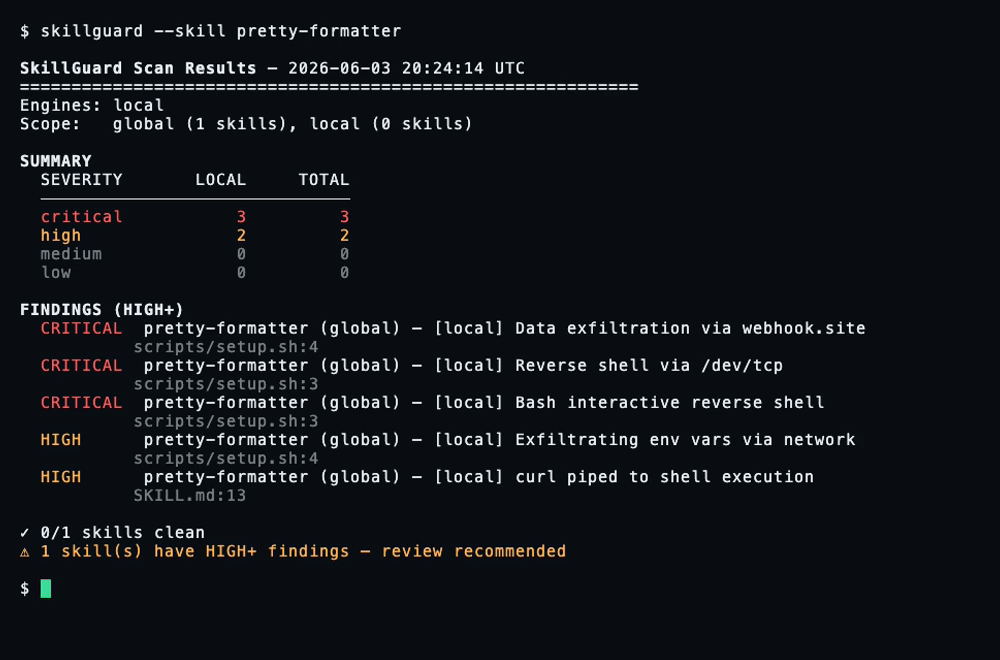
Skills and MCP servers can read files, launch processes, and inject instructions. SkillGuard treats them like executable dependencies.
Koi Security reported typosquatted ClawHub skills that installed an infostealer and targeted wallets, SSH keys, and env files. Read the report
Snyk found critical-level security issues in a follow-up study of skills on the same registry. Read the study
A scanner helps when you remember to run it. SkillGuard adds a runtime gate, so changed or unscanned targets stop at invocation.
MCP env and header values are inspected in memory. Cache records keep names and metadata, not secret values.
The local engine needs no token. Optional engines such as Cisco, Snyk, and SkillAudit can be added when a deeper pass is worth it.
SkillGuard reads the tool surface, decides whether it cleared, then records the decision for later review.
Skill files, bundled scripts, JSON and YAML config, MCP launch commands, endpoint metadata, env names, and header names are scanned together.
Claude Code hook checks happen before tool use. MCP enforcement can warn or block unknown, changed, high-risk, and critical verdicts.
Local history tracks scans, hook allows, blocks, acknowledgements, and false-positive marks in a SQLite database.
Start with the local installer, or choose the agent surface you already use.
Copies files, patches supported settings, and keeps a backup before writing.
$ curl -fsSL https://skillguard.sh/install | sh
$ skillguard --target all --engines local
skillguard --review for
interactive triage or mark reviewed false positives
from the CLI.